Sustainable Construction That Actually Saves Money: Myth vs Reality
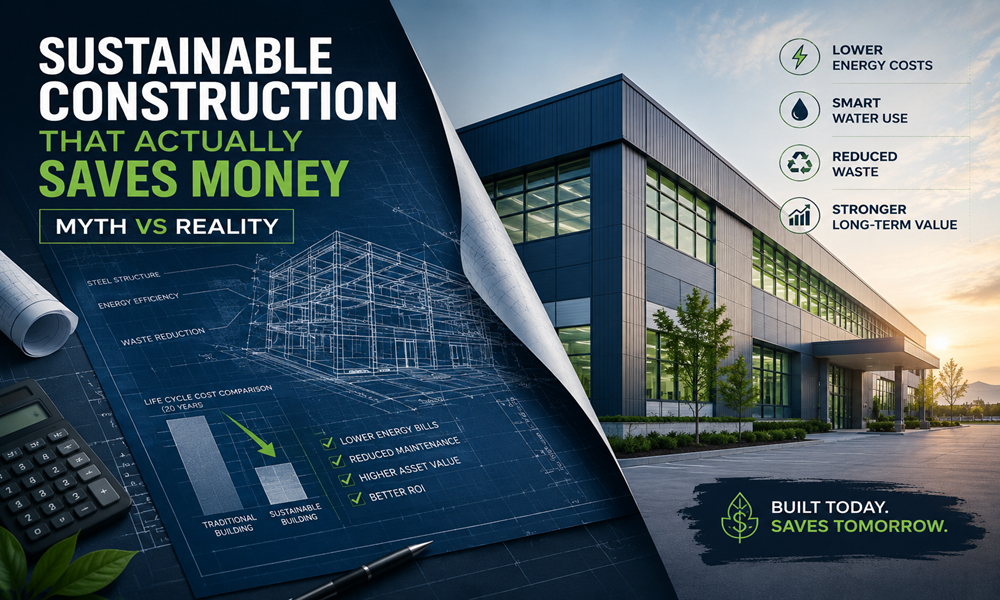
For years, sustainable construction has carried a strange reputation in the building industry. People love the environmental idea, but the moment budgets come into the discussion, many assume green construction is only for luxury projects, government buildings, or companies with extra money to burn.
That assumption has created one of the biggest myths in modern construction. Builders, investors, and property owners often think sustainability means expensive materials, complicated designs, and a long return on investment. So they continue choosing traditional methods, believing they are making the financially safer choice.
Yet the market data is telling a very different story. Today, sustainable construction is no longer just about solar panels and eco-friendly branding. From energy-efficient design to waste reduction systems and even prefabricated steel buildings, developers are finding that the right sustainable decisions can cut operating expenses, reduce maintenance, and improve long-term asset value in measurable ways.
The important phrase here is the right sustainable decisions.
Because yes, some green upgrades are overpriced and unnecessary. But many are practical money-saving tools hiding behind the label of “sustainability.” This blog breaks down the biggest myths, compares them with financial reality, and shows where sustainable construction truly saves money and where people misunderstand the numbers.
Why Sustainable Construction Is Still Considered Expensive
The sustainable building conversation has suffered from a branding problem. Most people hear words like green materials, net-zero design, and eco-certification and immediately imagine premium invoices.
That mental image is not random. Early sustainable construction did involve niche materials and specialist consultants, which made projects look inaccessible. But the market has changed much faster than public perception.
Today, many cost-saving sustainable solutions are standard engineering practices rather than elite architectural experiments.
The old image of green building still controls buyer psychology:
Ten years ago, sustainable construction was sold like a premium lifestyle feature. Developers highlighted bamboo interiors, rooftop gardens, imported insulation systems, and high-end environmental certifications.
As a result, business owners began linking sustainability with unnecessary decoration instead of practical savings. They assumed green means “more money spent before construction even starts.”
This old image still affects:
- warehouse owners,
- factory builders,
- residential investors,
- and commercial
Many skip sustainable options before even seeing the financial math, which is exactly where the misunderstanding begins.
Upfront cost and lifetime cost are often confused:
This is the biggest mistake in construction budgeting. Traditional buyers usually ask one question: “How much more do I pay today?” Smart developers ask a different question: “How much less do I pay over the next 10 to 20 years?”
According to the World Green Building Council, the direct operating savings from green buildings often exceed their additional construction premiums within a reasonable payback period through lower energy, water, and maintenance costs.
That means the real cost conversation cannot stop at material purchase. It has to include:
- electricity bills,
- cooling costs,
- repair frequency,
- water usage,
- tenant value,
- and resale
Once lifetime cost enters the room, the entire sustainable construction debate changes.
Myth vs Reality: Does Sustainable Construction Really Cost More?
This is the question every owner asks first, and honestly, it is the right question. No one wants to spend extra money because of a trend.
But the answer is not a simple yes or no. Sustainable construction costs more only when the project uses unnecessary premium features without financial planning. Practical sustainability often behaves differently.
Myth: Green buildings need a huge premium budget
Many people assume sustainable buildings need 20% to 30% extra investment.
That number scares small and medium investors immediately, so they return to conventional building methods. But several industry reports show that the additional upfront premium for many green building features is now relatively narrow when planned early.
The World Green Building Council notes that many green design premiums are modest and are regularly recovered through operational efficiency.
This is because many sustainability measures today are no longer rare:
- LED systems are standard,
- Rainwater harvesting is affordable,
- insulated panels are mass-produced,
- Daylight optimization is design-based,
- Waste-controlled fabrication reduces
So the “green equals massive premium” statement is outdated in many cases.
Reality: The expensive part is often traditional inefficiency
This sounds surprising, but conventional construction hides costs in places people ignore:
- poor thermal performance,
- high monthly utility bills,
- frequent repainting,
- moisture damage,
- excessive water use,
- and repeated material
These are not one-time bills. These are slow monthly leaks. When developers compare only initial construction invoices, traditional buildings look cheaper. When they compare 10-year ownership costs, many traditional projects start looking financially weak. That is why sustainable construction that saves money is not about spending more. It is about removing recurring inefficiencies.
Where Sustainable Construction Actually Saves Real Money
Now we come to the part most blogs skip. Instead of general environmental claims, let us identify the exact pockets where money is saved. Because sustainable construction is financially useful only when it improves measurable building performance.
1. Lower energy bills year after year
Buildings consume money every single day after handover. Lighting, HVAC systems, ventilation, heat gain, cooling demand, and machinery support create an invisible monthly expense. If the building shell is poorly designed, these bills stay high forever.
The World Green Building Council reports that green buildings commonly save around 10.5% in operating costs within the first year and nearly 17% over five years.
This happens through:
- insulated roofing,
- natural daylight planning,
- reflective materials,
- efficient ventilation,
- and low-energy
Even simple thermal improvements reduce cooling dependency significantly in hot regions.
2. Lower maintenance expenses
Maintenance is one of the most underestimated financial drains in property ownership. Conventional low-grade materials often mean:
- corrosion,
- cracks,
- leakage,
- peeling paint,
- and repeated structural touch-
The U.S. Green Building Council states that LEED buildings have shown almost 20% lower maintenance costs than standard commercial buildings. That is not a branding benefit. That is direct ownership savings. Using durable roofing, water-resistant detailing, long-life cladding, and quality ventilation systems reduces the number of times owners have to “fix the building again.”
3. Reduced material waste during construction
Traditional construction sites waste enormous amounts of money quietly.
Cut material, broken blocks, excess concrete, damaged sheets, site theft, and incorrect fabrication measurements all eat into project budgets. Sustainable construction emphasizes efficient planning and precision-based execution.
This includes:
- modular components,
- accurate quantity estimation,
- recyclable material use,
- and off-site
Less waste means less repurchase and less disposal cost.
4. Better long-term property value
A building is not just an expense. It is an asset. And increasingly, efficient buildings are valued differently in the market because buyers now look at the monthly operating burden before purchasing or leasing. Recent Asia-Pacific green building data shows certified efficient buildings can command rental premiums up to 11% while maintaining stronger occupancy rates.
So sustainability does not only save monthly money. It can increase:
- tenant demand,
- resale confidence,
- and investment
Quick Financial Comparison: Traditional vs Sustainable Building Ownership
Before we go further, this table makes the reality easier to understand.
| Cost Factor | Traditional Building | Practical Sustainable Building |
| Initial Material Cost | Slightly lower in some cases | Slightly moderate |
| Labor Waste | Higher | Lower due to planning |
| Monthly Energy Cost | High | Lower |
| Water Consumption | Higher | Reduced |
| Maintenance Frequency | Frequent | Less frequent |
| Building Lifespan Efficiency | Moderate | Higher |
| Tenant/Resale Appeal | Standard | Better |
| 5 to 10 Year Ownership Cost | Significantly higher | Lower overall |
This is exactly why many developers no longer ask “Is green building expensive?” They ask, “How expensive is it to keep building inefficiently?”
Which Sustainable Construction Methods Give the Best Return?
Not every eco-friendly feature gives a strong ROI. This is where many owners make poor choices. They install visible green items for image value, but ignore the hidden systems that save actual money.
High ROI sustainable decisions that work in real projects
The most financially practical methods are usually these:
1. Energy-efficient building envelope
Insulated walls, roof panels, reflective sheets, and ventilation design reduce cooling and heating pressure. This is one of the fastest payback areas because utility bills begin dropping immediately after occupancy.
2. Water management systems
Rainwater harvesting, low-flow fixtures, greywater reuse, and drainage planning reduce water consumption, especially in industrial or high-usage properties. Over years, this has become a serious operational advantage.
3. Modular and off-site fabrication
Factory-made components reduce site delay, labor inefficiency, and raw material damage. Projects using modular systems usually move faster with tighter cost control.
4. Long-life durable materials
Cheap materials often cost more later because replacement begins early. Good cladding, corrosion-resistant framing, coated roofing, and stable flooring reduce recurring maintenance bills. These are boring choices, but financially brilliant ones.
Low ROI green decisions that are often oversold
Some developers spend heavily on:
- decorative green facades,
- overcomplicated automation,
- imported designer sustainable finishes,
- or expensive certifications without a business
These may look attractive in brochures, but do not always generate proportional savings. This is why sustainable construction should never be emotional. It should be engineering-led and budget-led.
Real Industry Numbers That Change the Conversation
At this point, it helps to step away from theory and look at broader market figures. Because one builder’s opinion can be biased, but global trends show whether sustainability is financially maturing.
Important statistics every investor should know:
Here are some highly cited market findings:
| Verified Sustainable Building Statistics | Source |
| Green buildings can use around 25% less energy than non-green buildings in the US. | WorldGBC industry summary |
| Green renovations can reduce operating costs by almost 10% in one year. | USGBC |
| LEED buildings report nearly 20% lower maintenance costs. | USGBC |
| Green buildings can reduce operational cost up to 37% in some markets | World Bank green buildings finance report |
| Energy savings alone often offset cost premiums in a reasonable payback period | WorldGBC |
These numbers explain something important. Sustainable construction is not surviving because of environmental activism alone. It is growing because businesses are seeing balance-sheet advantages.
The Biggest Mistakes People Make When Trying to Build Sustainably
Now comes the reality check. Some owners do try to build green, but still fail to save money. Why? Because they misunderstand what sustainable means.
Mistake 1: Chasing labels instead of savings
Many builders spend money to make the project look eco-friendly rather than function efficiently. They choose visible green accessories but ignore:
- insulation,
- drainage,
- airflow,
- structural durability,
- and maintenance
That creates a green-looking building, not a cost-saving building.
Mistake 2: Adding sustainability too late in the project
If green decisions are added after drawings, procurement, and contractor planning are done, the cost naturally rises. Sustainability works best when integrated from:
- site planning stage,
- orientation stage,
- structural system selection,
- and material
Late changes feel expensive because they are retrofits, not planned efficiencies.
Mistake 3: Choosing low upfront cost over low ownership cost
This is the oldest trap in construction. Owners save money on:
- roofing thickness,
- ventilation quality,
- waterproofing,
- structural coating,
- or drainage
Then they spend the next decade paying for those shortcuts. Cheap construction is often expensive in ownership, wearing a disguise.
So, Is Sustainable Construction a Myth or a Financial Reality?
By now, the answer is clearer. The myth is not that sustainable construction is expensive. The myth is that traditional construction is automatically cheaper.
Once you include:
- energy consumption,
- water use,
- repairs,
- occupancy performance,
- asset value,
- and operational lifespan,
The financial story changes dramatically.
Sustainable construction saves money when it is practical, not performative.
This sentence matters. Sustainable building does not save money because a brochure says eco-friendly.
It saves money when the project uses:
- efficient systems,
- durable materials,
- waste-controlled methods,
- and long-life
That means sustainable construction should be treated as a financial strategy, not just an environmental slogan. Developers who understand this are no longer asking whether green construction is worth it. They are asking which sustainable choices create the strongest return.
And that is the smarter conversation the building industry should be having.
Before You Leave-
Sustainable construction has finally moved out of the idealism zone and entered the practical business zone. The builders making the highest long-term returns today are often not the ones spending the least, but the ones spending wisely on efficiency, durability, and future operating control.
So yes, some green upgrades are myths. Some are overpriced. But many sustainable construction methods are quietly doing what every investor wants most: cutting waste, lowering monthly bills, protecting property value, and reducing maintenance headaches year after year.
Whether it is energy-smart commercial planning, modular systems, or something as function-focused as a durable 3 car garage, the future of profitable construction is becoming very clear: sustainability works best when it is built for numbers, not just for image.
-
-
-
-
/ 0 Comments